

 Français
 Español
 Products

 About Us





Quick Answer
A fenestrated tracheostomy tube is a tracheostomy tube with one or more openings, called fenestrations, in the outer cannula. These openings can provide a pathway for air to move from the trachea toward the upper airway when the tube is used in an appropriate configuration. This may support upper-airway airflow and phonation in selected patients.
A fenestrated tracheostomy tube differs from a standard non-fenestrated tube because it contains one or more openings in the curved portion of the outer cannula.
These openings change the possible airflow pathway through the tracheostomy system. Depending on the tube configuration, cuff status and airway condition, air may pass through the fenestration and travel upward toward the larynx and vocal cords.
What Is a Fenestrated Tracheostomy Tube?
The defining feature of a fenestrated tracheostomy tube is the presence of one or more openings in the outer cannula. These openings are known as fenestrations.
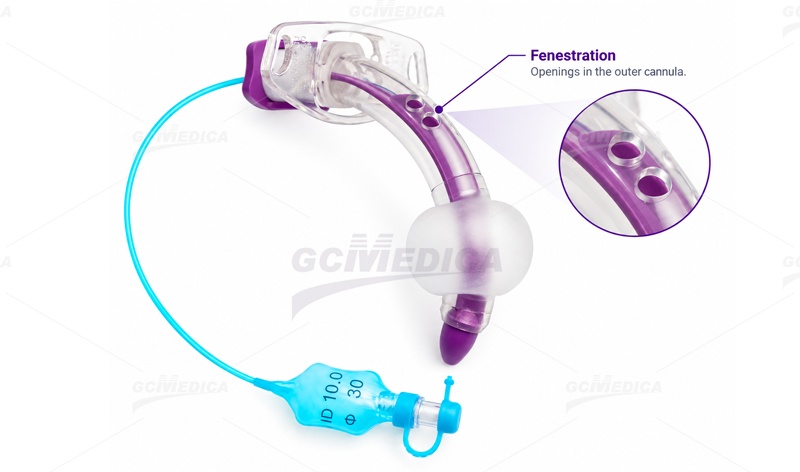
A fenestration provides an additional route for airflow. When the opening remains unobstructed and the tube is used in a suitable configuration, expiratory air can move upward through the upper airway instead of leaving only through the tracheostomy tube.
This is why fenestrated tracheostomy tubes are commonly associated with upper-airway airflow, phonation and speech.
For product specifications, available sizes and configurations, see the GRASMERE Fenestrated Tracheostomy Tube .
How Does a Fenestrated Tracheostomy Tube Work?
The function of a fenestrated tracheostomy tube depends on the relationship between the outer cannula, fenestration, inner cannula and upper airway.
Airflow pathway: Trachea → Fenestration → Upper Airway → Larynx / Vocal Cords → Mouth and Nose
In a non-fenestrated configuration, respiratory airflow primarily passes through the tracheostomy tube. A fenestration creates another possible pathway for air to move upward through the airway.
If airflow reaches the larynx and passes across the vocal cords, phonation may become possible. However, the actual airflow pathway depends on the tube configuration, cuff status, airway patency and inner cannula design.
Main Components of a Fenestrated Tracheostomy Tube
A fenestrated tube shares many components with other tracheostomy tubes. The main structural difference is the presence of the fenestration and the way it interacts with the airway pathway.
| Component | Definition | Main Function |
|---|---|---|
| Fenestration | One or more openings incorporated into the curved portion of the outer cannula. | Provides an additional pathway for air to move toward the upper airway. |
| Outer Cannula | The main structural tube positioned within the trachea. | Maintains the airway and contains the fenestration. |
| Inner Cannula | A removable component positioned inside the outer cannula in compatible tube systems. | Its design can affect whether the fenestration remains open or covered. |
| Cuff | An inflatable component located around the distal portion of cuffed tubes. | Creates a seal between the tracheostomy tube and tracheal wall when inflated. |
| Connector | The proximal interface used to connect compatible respiratory equipment or accessories. | Provides the connection point between the tube and compatible equipment. |
| Pilot Balloon | A small external balloon connected to the cuff inflation system. | Forms part of the cuff inflation system and indicates that the cuff system contains air. |
For a broader explanation of these structures, see Parts of a Tracheostomy Tube .
What Is a Fenestrated Tracheostomy Tube Used For?
The use of a fenestrated tracheostomy tube depends on the patient's airway status, respiratory requirements and clinical assessment.
Supporting Phonation
One of the most recognized functions of a fenestrated tracheostomy tube is to support airflow toward the vocal cords. If air can pass through the fenestration and reach the larynx, phonation may be possible in suitable patients.
Restoring Upper-Airway Airflow
The fenestration can provide a pathway for air to move from the trachea toward the upper airway rather than flowing only through the tracheostomy tube.
Selected Tracheostomy Weaning Situations
Fenestrated tubes may also be considered in selected airway-management and tracheostomy-weaning situations. They are not a universal requirement for weaning or decannulation, and tube selection depends on individual clinical assessment.
Fenestrated vs Non-Fenestrated Tracheostomy Tube
The main structural difference between a fenestrated and non-fenestrated tracheostomy tube is whether the outer cannula contains an opening that allows an additional pathway for upper-airway airflow.
| Feature | Fenestrated Tube | Non-Fenestrated Tube |
|---|---|---|
| Fenestration | One or more openings are present in the outer cannula. | No fenestration is present. |
| Upper-airway airflow | Can provide an additional pathway toward the upper airway. | Does not provide an airflow route through a fenestration. |
| Phonation | May support airflow toward the vocal cords in suitable conditions. | Requires another pathway for air to reach the upper airway. |
Can a Fenestrated Tracheostomy Tube Be Cuffed or Uncuffed?
Yes. Fenestrated versus non-fenestrated and cuffed versus uncuffed describe two different structural characteristics of a tracheostomy tube.
Fenestrated / non-fenestrated: describes whether the outer cannula contains a fenestration.
Cuffed / uncuffed: describes whether the tube includes an inflatable cuff.
This means a fenestrated tracheostomy tube may be available in either a cuffed or uncuffed configuration depending on the product design.
GCMEDICA offers the fenestrated tracheostomy tube in cuffed and uncuffed configurations , with multiple tube sizes available for different product requirements.
What Is a Fenestrated Inner Cannula?
A fenestrated inner cannula is an inner cannula that contains an opening designed to align with the fenestration in the outer cannula of a compatible tube system.
When the openings are correctly aligned, airflow can continue through the fenestration toward the upper airway.
A non-fenestrated inner cannula may cover the outer-cannula opening and therefore change the airflow pathway. Because tube systems differ between manufacturers and models, the specific configuration should always be understood according to the device instructions for use.
Fenestrated Tracheostomy Tube vs Speaking Valve
A fenestrated tracheostomy tube and a speaking valve are both related to upper-airway airflow and phonation, but they are not the same type of device.
A fenestrated tracheostomy tube is a tube design that incorporates openings in the outer cannula. A speaking valve is an accessory used with an appropriate tracheostomy configuration to redirect expiratory airflow toward the upper airway.
The appropriate method depends on the patient's airway, tube configuration and professional clinical assessment.
Important Considerations
Because the fenestration creates an opening in the outer cannula, correct tube selection, positioning and management are important.
Secretions may collect around the opening, while poor alignment of the fenestration may affect airflow. Other considerations can include mucosal irritation and granulation tissue.
Important: A fenestrated tube is one possible tracheostomy configuration rather than a universally preferred tube design. Selection and use should follow the applicable device instructions and professional clinical assessment.
Frequently Asked Questions
What does fenestrated mean in a tracheostomy tube?
Fenestrated means that the tracheostomy tube contains one or more openings in the outer cannula. These openings can allow air to move from the trachea toward the upper airway.
What is the purpose of a fenestrated tracheostomy tube?
Its main structural purpose is to create an additional pathway for upper-airway airflow. In selected patients, this may support phonation and broader airway-management goals.
Can a fenestrated tracheostomy tube help a patient speak?
It may support phonation by allowing air to travel toward the larynx and vocal cords. Speech also depends on airway patency, cuff status and the overall tube configuration.
What is the difference between fenestrated and non-fenestrated tracheostomy tubes?
A fenestrated tube has one or more openings in the outer cannula, while a non-fenestrated tube does not. The fenestration creates an additional potential pathway for airflow toward the upper airway.
Can a fenestrated tracheostomy tube be cuffed?
Yes. Fenestration and cuff configuration are separate design characteristics. Fenestrated tracheostomy tubes may be available in cuffed or uncuffed configurations.
Summary
A fenestrated tracheostomy tube contains one or more openings in the outer cannula that can provide an additional route for airflow toward the upper airway. This structural feature distinguishes it from a non-fenestrated tracheostomy tube.
The function of the fenestration depends on the overall tube configuration, including the inner cannula and cuff status. In suitable conditions, the design may support upper-airway airflow and phonation.